Missoula's own Ten Spoon winery held its annual grape harvest this weekend. Members of the community were welcomed onto the vineyard, fed very well, and put to work with a pair of scissors. The Ten Spoon winery is an example of a valuable asset to Missoula nestled in the high-property-value Rattlesnake valley.
Jen and I topped off the day by driving another mile up the road and biking into the Rattlesnake wilderness area. I've been told that the Rattlesnake is the closest federally protected wilderness area to a major metropolitan area. Mount Rose is pretty close to Reno, and Mount Sandia abuts the suburbs of Albuquerque, but we're at least in the running.

Sunday, September 30
The fruits of our labor
topic:
Food Sources,
Missoula
Friday, September 28
Book: The City in History
topic:
Reading List
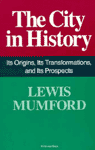 By Louis Mumford. This work from 1961 is often recognized as the top of the list in the urban planning canon. While it took a little while for me to get used to his incredibly erudite style, I found myself being drawn into his vision more and more as I read. He writes in a style of history that moves seamlessly between hard archaeological facts and wildly philosophical speculation, maybe a little reminiscent of Gibbon's history of Rome. I'm personally not put off by a mixture of intellectual history and "actual" history, but I can understand how it may frustrate some. He's also very selective in his focus, but that also makes his own argument much more cohesive. One important caveat: It really should be titled, "The City in Western History."
Overview: [this is painfully brief]. Humans moved away from a low-density hunter and gatherer system as the Neolithic era arrived. Villages became centers of the sacred as well as agricultural storehouses, merging "feminine" domesticity and civilization with "masculine" drive for dominance. Technological innovation, moral and legal systems, political and religious bureaucracies, and a market economy all fed and were fed by urbanization. All elements of urban space were in place by 2500 B.C.
The city functioned as both a magnet and a container. Various forces drew the population together, and literal walls were in place to protect from military aggression and maintain the density necessary for civic life. Walls, whether physical or not, are a trans-historical and essential fixture of urban space.
Early Greek civilization developed because distinct city-states were formed, geographically isolated from each other. This allowed strong urban and rural interaction and kept governance local. Human expression flourished despite lacks in sanitation and elaborate infrastructure. However, eventually, the Greeks turned the polis into a god itself, a testament to mankind's own dominance. Utopian dreams of Plato and the empire of Alexander unraveled Greek society. Rome followed in this mold, failing to respect natural limits to growth and the moral decay it leads to. "Barbarism captured the city from within."
Christianity, which embraced suffering, began a revival of the localized city, even in the midst of economic collapse. The monastery and the citadel were the central features. The medieval city grew organically and fostered a rich and diverse social life. Sanitation standards were low, but this was offset by the availability of open space outside the boundaries of town. Corruption in the Church and among feudal lords began to challenge the medieval city.
The baroque period brought the cycle back to "centralized mass organization." Static and rigid planning was imposed from above, rather than organically ushered from below. Grids replaced meandering streets. Military objectives were in the forefront of city design. Nationalism drew large populations to the capital centers. Class stratification intensified. The city was pitted against nature. Commerce and politics became the most important functions of the city. The industrial revolution and rise of full-fledged capitalism intensified this process.
There were many reactions. Some pursued the mistaken belief that a proletarian revolution would solve the problem. Many others began to flee this city, while enjoying the benefits at the same time. "cult of nature" merged with the "horrors of industrialism" to provoke suburbanization. It started out as successful, but became a disaster as it grew in popularity. Surburbs are "anti-city." The old credo of the planner Unwin, "nothing gained by overcrowding" should be supplemented by "something lost by overspacing."
A modern faith in technological progress and totalitarianism is currently leading to a dystopia of "post-historical man." But history is not deterministic. The solution is to decentralize, privilege organic growth, respect natural limits to human society, promote "invisible" networks between cities (foreshadowing the internet?), and restore a sense of the divine that transcends our thirst for material power.
Engagement: The combination of Mumford's passion, encyclopedic knowledge, and and sustained focus made this book a treat to read, even if he does get carried away at times. It is fascinating to see how he relates big-picture values to something as mundane as the layout of a city sewer system.
The clear message throughout: small, organic, and diverse over large, organization, and monotonous. Pre-socratic Greek and Medieval civilization is preferred over Roman and modern civilization, although his stance is not entirely without nuance. A good example of this is the difference between the medieval winding streets, based on the visual and accessible scope of a human pedestrian, and the straight baroque avenue, designed for military and elite wheeled vehicle access and as a means for displaying power with parades.
Arising from the discussion (302) of this difference, he writes,
"Organic planning does not begin with a preconceived goal; it moves from need to need, from opportunity to opportunity, in a series of adaptations that themselves become increasingly coherent and purposeful, so that they generate a complex, final design, hardly less unified than a preformed geometrical pattern."
Saturday, September 22
Specialized experts, specialized places
topic:
Philosophical Basis
In a lecture given a few months ago, Andres Duany expressed some frustrations involved in trying to implement New Urbanist principles in development, even though wide-spread public support is already there.
"Developers are specialized. One of the reasons that mixed-use is difficult is that developers will come up and say, "I'm greatly sympathetic with what you are doing, but I only do houses." And another one says, "I only do rental apartments." Another says, "I only do shopping malls" ... It's all absolutely normative so it plugs easily into that system."
He expands this further. The transportation analysts are well-acquainted with the current traffic models. The environmentalists only know their respective watersheds or animal habitats. The bankers want to finance the projects they have experience with. Each niche seeks to influence a project toward its own goals using its own skill set, and this leads to a preference for a system that can be easily dissected and quantified.
This is an interesting thought: could specialization of professions and expertise into tight niches lead to the specialization of urban land use into separately demarcated zones?
Steve Hardy, of the blog Creative Generalist, explains the need for people who can synthesize ideas and facilitate a cross-pollination between the various specialties. From his manifesto:
"Nothing substitutes depth of analysis and there’s proven value in the methodical and incremental process of specialization—it’s what education, career paths, scientific research, and technological innovation are built on—but generalism is the hidden talent, the missing link. With so much complex information, that is fragmented in so many ways and developing faster and faster, it is increasingly important to have generalists around to make sense of it all. People who appreciate diversity, who are in the know about the wider world, and who understand how things interact are invaluable observers, matchmakers, and pioneers of the inteeconomy."
Is this the role the planner?
Thursday, September 20
An open space bond at work
topic:
City Boundaries,
Missoula
New West has been running a series of stories about how Missoula's open space bond is being used. In the most recent installment:
"It's not just for treasured viewsheds like the hills around Missoula. Traditional agricultural and timber lands -- working lands -- protect Montana's heritage, too."
The story is about the Hayes' family farm, sitting on a location in the Blackfoot valley that may be enticing to developers. Money from the open space bond is being used to purchase the development rights for the farm, ensuring that the property will never be sold and subdivided into separate parcels. It can only reasonably be maintained as a working farm.
This has the feel of a win-win situation. The family gets relief from the constant pressure to give up their legacy of farming, which goes back to 1887, and the wider community benefits from the maintenance of the rural landscape. A true success. The only challenge left to Missoula is to find an affordable place to put those people who would have moved onto the land. Open space and urban density are two sides to the same coin.
Tuesday, September 18
The farmer's market fixture
topic:
Food Sources,
Missoula
 Missoula's thriving farmer's market has been our Saturday morning entertainment and food scavenging ever since I've lived here. I sometimes imagine a juxtaposition of the outdoor market and the standard supermarket. On one side is the hard florescent lights, the tinny Bee-gees song in the background, the constant assault of flashy marketing, the check-out line tabloids. On the other side is the sunlight, the local street musician, the vibrant colors of the arranged produce, and plenty of quick conversations with friends. That's not to mention the quality of the food itself.
Farmer's markets are growing in popularity around the country, with about an 18% increase in quantity in the last 10 years. And many folks are finding that the local market, contrary to established wisdom, is not necessarily the more expensive option. The economy-of-scale advantage of the supermarket is offset by the lack of the local farmer's "value-added" elements (processing, packaging, marketing, distributing). Jen and I probably do end up spending more at the farmers market, but it's cash so we don't really keep track of it. And I'm reminded of the benefits by the pork ribs currently stewing in the oven.
It's great to see the resurgence of this most ancient fixture of city life, that original connection between the urban world and the countryside that sustains it. Its organically formed system of commerce will hopefully never be fully replaced.
Sunday, September 16
Bicycles are Not Transportation ...
topic:
Transportation System
and neither is walking.
So says U.S. Secretary of the Transportation, Mary Peters, who claimed that bike paths and trails were partially to blame for the Minneapolis bridge collapse last month. Here's the transcript of the PBS NewsHour appearance.
I have to jump on the bandwagon with this one, even if the bloggers and various transportation organizations have been all over this for weeks. I spent a half an hour reading through the blog search results for "Mary Peters" and I could not find a single voice of support. Why the (obviously contrived) attack on alternative transportation? One would think a transportation secretary would want to support practices that spare congestion and save infrastructure costs.
A Salon.com article from a couple of days ago theorizes about what could be behind this:
Peters is on a campaign to quash the idea of raising the gas tax, as she editorialized recently in the Washington Post. A key proponent of raising the gas tax to fund bridge restorations in the wake of the Minneapolis bridge collapse is Democratic Rep. Jim Oberstar of Minnesota, who has advocated for bike and pedestrian paths in his district. By putting a culture-war spin on the bridge collapse, Peters is hoping to run his gas tax proposal off the road.
Friday, September 14
Confronting my inner NIMBY
topic:
Philosophical Basis
From what I read, anyone involved in land use planning butts heads with the ubiquitous NIMBYs over and over again. NIMBYs (not in my backyard) are folks who may agree with a certain project in principle, but will fight tooth and nail to place that project somewhere else; anywhere else. For example, a homeowners' association may oppose the placing of a charitable group home in their neighborhood, fearing that it could lower property values and sully the "character of the environment." Last month residents in a posh British locale did just that to a proposed house for soldiers recovering from war casualties. Not a good PR move, as it turned out.
But it's not just the unusual requests that stir up controversy. In a survey last year, the Saint Consulting group found that "73% of all Americans oppose new development in their communities." That's why so many of us can wax poetically about the spiritually degrading suburban sprawl and we all nod our heads in approval. But what do we really want? We want enough sprawl to justify our own living situation, but not quite so much that we have to share it with others. We'd rather have that preserved woodland abutting our property than another damn suburbanite. That's why we escaped the city in the first place!
In my more cynical and depressing moments I wonder how much of the political steam for many good endeavors - conservation easements, smart growth regulations, open space bonds - comes from these motivations.
The philosopher Immanuel Kant, in all his hyper-rational glory, famously suggested that morality rests on the principle of duty: "act only in accordance with that maxim through which you can at the same time will that it become a universal law." This is the first expression of what he called the Categorical (for everything) Imperative (do it). Kant poses the question to us NIMBYs: what if everyone succeeded in pushing out these necessary services from their immediate surroundings. You don't want a water treatment plant, but do you want treated water. I chose to approach this from Kant because it lends this simple principle an air of sophistication, but I could have just as easily gone with Jesus (or your grandmother): "do to others as you would have them do to you."
This is harder than it looks.
I want to keep this in mind as I pursue a vision for what our built environment can look like. Sustainable, equitable, beautiful - all of that good stuff means precisely nothing if I am personally not willing to shoulder my share of the burden when it unfolds in reality. I'm convinced that the major obstacle that lies before creating the types of communities we all want lies in the individual human heart, not primarily in our social and political machinations.
Subscribe to:
Posts (Atom)