Saturday, April 24

Kunstler is not really the face of smart growth

Kunstler and O'Toole meet for the first time. Source: Brown PTP
I just watched a debate held last week at Brown University between James Howard Kunstler and Randal O'Toole entitled "Building America: who should control urban growth?" Halfway through, I began to wonder whether the debate organizers had taken two separate presentations and spliced them together with Adobe Premiere. They were not only not actually disagreeing (which is helpful in a debate), but they weren't even starting with the same questions.

Kunstler, with his characteristically vivid language ("Phoenix is going to dry up and blow away. We're done with that"), spells out the inevitable collapse of the entire American energy and financial system, while O'Toole compares charts of data for federal subsidies of various modes of transportation. The closest Kunstler gets to addressing O'Toole's (rather flamboyant) charts was simply to point out how easy it is to lie with statistics. That, and the fact that it's all coming to a crashing end. Case closed, I guess.

I have no interest in throwing Kunstler under the bus, but I want to stress that he has to be considered in the right context. He's a writer and provocateur. He's not at all a policy wonk nor a strategist. He's not even particularly interested in solutions. I like the way Eric Jacobsen characterized him a few years ago, as prophet, straight out of the Old Testament, proclaiming "repent for the kingdom of god is near." I would no more expect a detailed economic forecast from Kunstler than I would from the ancient itinerant Ezekial in sackcloth and ashes. A different mode of communication altogether.

Highway proponents like Randal O'Toole recognize Kunstler's eccentricities and are happy to characterize him as the face of smart growth. The fact that Kunstler is intensely critical of government planning and dismissive of larger cities doesn't seem to matter. In a recent blog post, O'Toole told his critics to "get their noses out of Kunstler’s biased diatribes," as if the writer himself were issuing marching orders to the hordes of planners and activists from his command post up in Saratoga Springs.

Suburban proponents have a lot to gain from casting Kunstler in this mastermind role, which helps explain why John Stossel keeps trying to get him to appear on his Fox Business show. A message of impending doom, whether true or not, is not particularly winsome to most Americans. Keep in mind that Kunstler's primary argument these days is not so much that compact, walkable neighborhoods are more desirable than sprawl, but that sprawl will be unavailable to us whether we prefer it or not. Telling an American they cannot have something makes us want it more, which is not necessarily a bad trait if it's coupled with hard work and ingenuity. This deep-rooted optimism does not work in Kunstler's favor.

Secondly, his writings are a veritable gold mine of quotable nuggets for anyone seeking to cast the central smart growth argument as aesthetic in nature, something opponents do all the time. Jarrett, from Human Transit, explains this tactic well,
"The standard move in these works is to treat environmental concerns as though they were aesthetic ones, and then take a long view in which these aesthetic arguments look narrow and culturally contingent, as aeshetic arguments always do.  This move -- ridiculing environmental judgments as though they were aesthetic ones -- is sadly common these days."
Find a quote calling all suburbanites clowns, or something equally unfair and derisive, and then earnestly defend these Americans' right to have their own housing preferences. Nevermind public health, social equity, environmental constraints, fiscal feasibility or any other reasoned arguments. The other side is only right-brained impressions and personal preferences, as O'Toole recently summarized the debate.

Finally, Kunstler's bluster, which is part of the show, doesn't always play well when it comes to actual policy debates. Calling his opponent a "rogue in the services of evil enterprises," as he did in a podcast prior to the debate, may get a laugh out of many of us but it also blurs the lines between entertainment and serious problem-solving. This comment also dives head first into the genetic fallacy. Even if O'Toole receives funding from highway interests, his arguments really need to be evaluated on their own merits. I know I'd be cool if someone wanted to pay me to say something I already believed.

For a truly fruitful critique of O'Toole, I would direct you to two places. Austin Bramwell, writing in the American Conservative, fires some posts back and forth with O'Toole. Bramwell's basic point is that the number of regulations and subsidies that mandate sprawl and motoring far outweigh those that encourage compact development and walking. He questions O'Toole's highly selective market approach. Or check out Matthew Yglesias's similar take. Although a progressive, he's fully willing to put on the libertarian shoes for the sake of debate. These are the kinds of responses that O'Toole's followers, at least those who are at liberty to have their own opinions, are likely to find more persuasive.

I still think Geography of Nowhere and Home from Nowhere are classic polemics. Kunstler can turn a phrase wonderfully and boil down the essence of an observation into a pithy and humorous line. He's just as witty in his weekly podcast with Duncan Crary. He's a showman, who once wrote that "an audience doesn't hunger for the truth so much as authenticity. They know the truth can be slippery."

In the spirit of niceness, I'd like to end with a great passage from Home from Nowhere,
"I feel an obligation to paint the landscape of my time, so I often paint the highways with cars on them and even roadside monstrosities like McDonald's and Kmart. I especially like the contrast between the artificial light of the electric signs and the natural twilight in the background. The result on canvas is oddly beautiful, but of course what's left out is the roaring traffic and smell of exhaust fumes. A few years ago, I was painting a McDonald's with my easel set in the bark mulch bed of a Burger King parking lot across the highway. I was well underway when the manager bustled out and barked, "that ain't allowed here!" I dared him to call the police. I would have loved nothing better than to be arrested for painting."
But this is not my bible. I don't think it was intended to be.

Wednesday, April 21

Necessity is the mother of vegetation in Havana

If you want to know how society might function in event of a serious economic downturn, Cuba is not a bad case study. When the Soviet Union imploded and no longer had the wherewithal to prop up an economy across the world, Cuba was thrust out on their own with very few options for trade with the outside. These dire circumstances have compelled local communities and individuals to devise creative and efficient ways to meet their own needs.

The movement of urban gardens in Havana seems like a natural outgrowth from this. It answers the question of how to help provide food for four million people without abundant oil supplies and transportation infrastructure.

A 2008 BBC segment sings the praises of Havana's urban gardening movement:


Although the basic need to eat certainly inspired these projects, the farmers are quick to point out all of the auxiliary benefits as well: the beautification of the city, a rallying activity for the community, and jobs for locals. The gardens range from green spaces squeezed tightly between walls on an urban lot to suburban small farms in close proximity to homes.

Monday, April 19

Church-based transit oriented development deemed legal

An Arlington, Virginia church, First Baptist Church of Clarendon, may have just paved the way for religious organizations to become more active players in affordable transit-oriented development. Last week, a U.S. District Court judge threw out a First Amendment lawsuit against the church's subsidized housing development, which claimed that their partnership with the county violated separation of church and state. This was only the latest in a series of attacks lodged against the development by affluent nearby residents, who claim the eight floors of apartments above the remodeled sanctuary ruin the character of their neighborhood. The proposed 116-unit addition (70 subsidized units) happens to sit one block from the Clarendon metro station.

My intention here is not to get into the legal details of the case, but just to point to the clear green light the church was given. The basic allegation was that Arlington County's support for the project was a veiled attempted to prop up a struggling church with public money. Barry Lynn, of Americans United for Separation of Church and State, called it "secular salvation." The judge, however, disagreed. He determined that providing highly accessible affordable housing is, in fact, a public purpose and there is nothing unconstitutional about the government partnering with a religious organization to meet these goals. It is relevant that all funds for the sanctuary remodel and preservation of the steeple did come from the church itself.

The NIMBY vs. TOD story is all too familiar, but the involvement of a religious organization in the process adds an interesting twist. If this development does come to fruition, and it is expected to by 2011, it will represent a win-win-win situation for housing advocates, the county government, environmentalists, and the church itself. The church gets to leverage it's valuable property assets to reinvigorate itself, while contributing toward it's mission for social justice at the same time. A number of families get a decent home right in the thick of everything they'll need. The rest of the community gets more density near transit and all of the attendant social and environmental benefits.

Church's have a long history of incorporating subsidized housing on site, going back to the ubiquitous parish house that was built to allow staff to live right on premises. The cooperative strategy modeled in Clarendon can be a wonderful opportunity to renew this tradition, especially for older congregations who occupy important urban sites but currently don't have the parishioners to fully utilize them. Adapting church preservation with new construction can breath new life into the building and mix uses that are quite compatible. I'm looking for this kind of partnership to spread to communities around the country.

Monday, April 12

The paradox of smart growth

Kaid Benfield's blog for NRDC has probably been the most consistently insightful of all of my regular reads. I still recall the first post I read back in the summer of 2008, on the carbon emission benefits of density. Prior to getting hooked on his blog, I was mostly interested in the the urban form for its benefits to community - think Robert Putnam - or for purely aesthetic reasons. The environment was always a part of it, but Kaid's persuasive and passionate reasoning helped shift the focus of my priorities on this blog. I'm sure I've stolen an idea or two over the last two years.

Images of Rockville's Twinbrook Station from NRDC Switchboard blog
I bring all of this up now, because his two recent posts are an excellent introduction to his blog.  I'd encourage anyone who has not stopped by to head over there now. No reason to finish reading this post.

The first post presents the paradox of smart growth among environmentalists, something he undoubtedly encounters on a regular basis.
"Environmental impacts will occur with development; to limit them, we must concentrate them, and this can mean increasing them in some places.  This is what I call the environmental paradox of smart growth.  Only if we understand the paradox can we address it.  Only if we address it can we really create better places in which to live, work, and play – and surely that, not just lowering pollution numbers, must be our real goal."
 (why are you still reading here? It's all just quotes and paraphrases at this point)

What is needed is density, diversity, and design. Approaching smart growth from an overly analytical perspective misses those intangible qualities and details that make a place truly livable. Kaid is always mindful of the fact that people have to want to live in the places that are built. The whole game is off if nobody actually lives in the whatever fully sustainable development we've imagined.

The second post seeks to address this design question. Rather than spelling out the "top 10 principles of good urban design" or something, Kaid simply provides some examples of recent compact developments that have also been beautiful. It's a refreshingly optimistic take on smart growth.

Sunday, April 11

Gardeners and urbanists unite

Michael Pollan is known for writing about food, but his first book still stands as a classic gardening autobiography. One of the enduring premises of Second Nature (and an earlier NYT feature) is his eloquent description of the strangeness and pervasiveness of American lawn culture: those sheer-cut acres of the same Kentucky Bluegrass layering the ground from coast to coast. Today, there are burgeoning lawn reform movements among gardeners to question the convention.

Research has measured the total acreage of lawns in the U.S to be about 40 million (and growing), making turf grass the number one irrigated crop in the country. Although yards may literally be green, there is very little environmental benefit to them.  The compacted soil functions as an impervious surface for stormwater run-off, and grass under six inches does little good for erosion control. The species monoculture of most lawns creates habitat dead space. A large chunk of household water use goes to lawn upkeep. Although they may sequester some carbon, the methane released by trashed grass clippings cancels a lot of this out. And the big one is the pesticides and fertilizers applied and washed into surrounding waterways.

Pollan asks: Why do we still do this?

The easy answer is because we have to. Many HOA covenants and zoning laws prescribe specific requirements for mowing and upkeep. If this doesn't do it, the often intense social pressure to mow will get the message across. But, sure, how did that regime come into existence? According to Pollan, the lawn conveys a number of important social messages:

"The American lawn is an egalitarian conceit, implying that there is no reason to hide behind hedge or fence since we all occupy the same middle class."
 And
"We are all property owners here, the lawn announces, and that suggests its other purpose: to supply a suitably grand stage for the proud display of one's own house."
The lawn also represents, and dramatizes on a weekly basis, our dominance over nature:
"For however democratic a lawn may be with respect to one's neighbors, with respect to nature it is authoritarian. Under the Toro's brutal indiscriminate rotor, the landscape is subdued, homogenized, dominated utterly."
His recommendation is to convert the lawn into a garden, that is, to subdue our patch of nature artfully, working with the rhythms of time and particularities of place. Sounds good, but this is where a sense of urban scale may help this transition along. It's hard for me to imagine the average large-lot suburban homeowner finding the time to creatively arrange a significant portion of his plot. Short of a sizable landscaping budget or loads of free time, most people will opt to simply fire up the riding lawnmower. You can even set your beer in the cup holder.

Small-lot homes on well-appointed streets are a much more manageable scale for most people. And there will be plenty of passers-by stopping on the sidewalk to admire the handiwork. A move toward more thoughtful and ecologically beneficial lawns is unlikely to be successful without a concurrent reform in overall land use patterns in America.

The accompanying pictures are of front yards that I found attractive on a quick ride around Charlottesville yesterday. Some are from more affluent neighborhoods and some less so, but they are all fronting a good street.


Wednesday, April 7

What is centralized planning anyway?


According to Carrión, smart planning involves a combination of walkable communities, mass transit, and bicycle paths, and who could argue with that, except that in the last 40 years, our faith in centralized city planning has changed radically. In short, we've lost it."
Planning as a discipline is used to shouldering frequent attacks from libertarians and property rights activists, but


Bus Images used from DragoArt


Our success will be that we encourage local communities to steer their way into the future in smarter ways, that local municipalities understand that they are part of a new complex of regional economies or metropolitan areas, and that they have shared destinies."
I don't see any muscular nationalism here at all, at least nothing reminiscent of the disastrous urban renewal days. All I see is a national interest in strong cities and the goal to help facilitate smart planning among communities.
"The purpose is to go and identify and amplify those creative solutions that communities have come up with."
Sounds more like a cheerleader than the quarterback. Characterizing this posture as too strong of a federal role is simply swinging the pendulum too far in the other direction.

Rob Goodspeed redirects question in more fruitful direction,
"The more interesting and accurate conclusion to draw from the failures of modernist city planning is to consider which forms of government planning are still active and desirable. In this sense, Rybczynski’s article is a bit behind the times. The tremendous interest in high speed rail, urban transit, green building codes, the government’s role in wind power and broadband, and housing finance regulation has reminded us of the central role of government in shaping our cities."

Monday, April 5

A practical art of sharing space

Some comments from last week’s post from Peter Sigrist and Eric Orozco stimulate a really interesting conversation about the feasibility of a pluralistic society living compactly. In Peter’s words: “could so many people with different values and customs avoid disastrous conflict” in a very dense living arrangement? Scrambling to come up with a response, it seemed worthwhile to launch a whole new post.

Has our diversity tended to spread Americans out from each other?

Pietro Nivola of Brookings thinks so,

“One may wonder whether nations that have lacked this spatial buffer, or that prefer to compress their urban populations into much closer physical proximity, could have kept a lid on urban social pressures comparable in duration and intensity to those withstood historically in America.”
From the anti-Catholic violence of the mid-19th century to the riots that shook inner cities in the 60’s, there’s ample evidence to suggest that the space available for outward movement served as a sort of “escape valve” for cultural tensions. Various groups responded by simply moving away, sometimes the affluent seeking greener pastures and sometimes dispossessed minorities being coerced to move on. This is an unavoidable part of the American story.

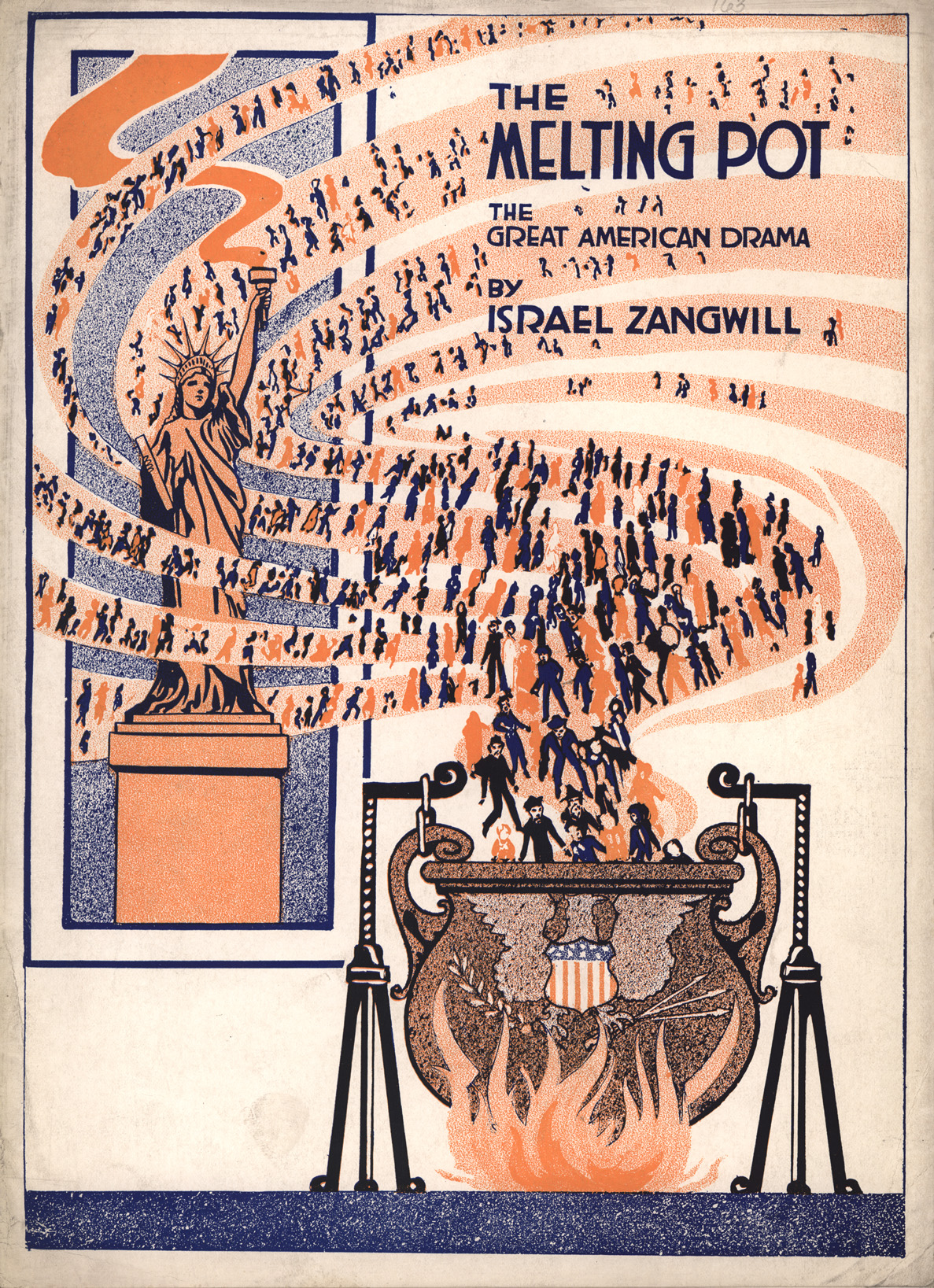
Multiculturalism is one of those ideas that have been investigated by the academy with a fine-toothed comb for decades. I was taught in elementary school that we were a “melting pot,” then we became the “salad bowl,” and now you may hear every imaginable metaphorical variety in between. I suspect this debate is a manifestation of what William James called the ancient question of “the One and Many.” How is everything unified? How is everything diversified? According to James, it’s unanswerable in the abstract - otherwise it would surely have been answered by now. All we really can do is see what arrangements along this spectrum meet our goals for specific, concrete situations.

Stanley Fish is probably the current torch-bearer of American pragmatism:
“We may never be able to reconcile the claims of difference and community in a satisfactory formula, but we may be able to figure out a way for these differences to occupy the civic and political space of this community without coming to blows.”
This is a call for strategy over theory; mitigation over solutions. It seems to me that this is the role urban planners have been playing in communities for years.

One strategy for “resolving” differences has always been privatization - an avoidance tactic. Another strategy is forging a common set of compromises that can govern peaceable use of the public (and the inevitable overlaps of the private). Each approach has its pros and cons, and probably both approaches are needed to some degree.

I live in a neighborhood in which I am a racial, and in some ways cultural, minority. This was an intentional choice, and warm evening walks passing families sitting out on their front porches remind me of the commonalities I share with my neighbors. Yet there are differences as well. To cite a trivial one, the same warm days allow me the opportunity to listen to loud music from passing cars that I definitely would not listen to in the comfort of my own home. This can be annoying to me, and the motorists are undoubtedly annoyed that I’m annoyed. Yet friends who own a bed and breakfast down the street are seriously advocating enforcement of noise ordinances for cars. It hits them in a different way.

I have no conceit that I’m experiencing an absolute pluralistic lifestyle. Not even close. Even given my relatively diverse spatial living arrangement, my life is predominantly privatized nonetheless. It’s not as if I’m hanging out in the neighborhood community center every day. I always have the opportunity to close the doors and retreat inward, or travel outside of the neighborhood. Diversity is nearby, but I'm hardly immersed in it.

All of this to preface the point:

I tend to be fairly optimistic about our chances for peaceful cohabitation of space, because it can be supplemented with reasonable doses of self-segregation, regulations for conflicting behavior, and the simple practice of closing the door or walling off the private garden. Every locality, indeed every household, will surely land on a different balance in their approach, but there are tried and true strategic options available for sharing space nonetheless.